Courses
Dr. Anna Szlavi’s Courses Making an Impact in STEM
Featured Course
Introduction to Gender Studies in Science and Engineering
Hosted at Johannes Kepler University (Austria), this project-based course explores gender inclusion, diversity, and innovation in STEM education and engineering through real-world student projects and collaborative learning. Students go on a journey of exploring a topic connected to inclusion in STEM that is meaningful to them and design their projects collaboratively in order to make an impact.
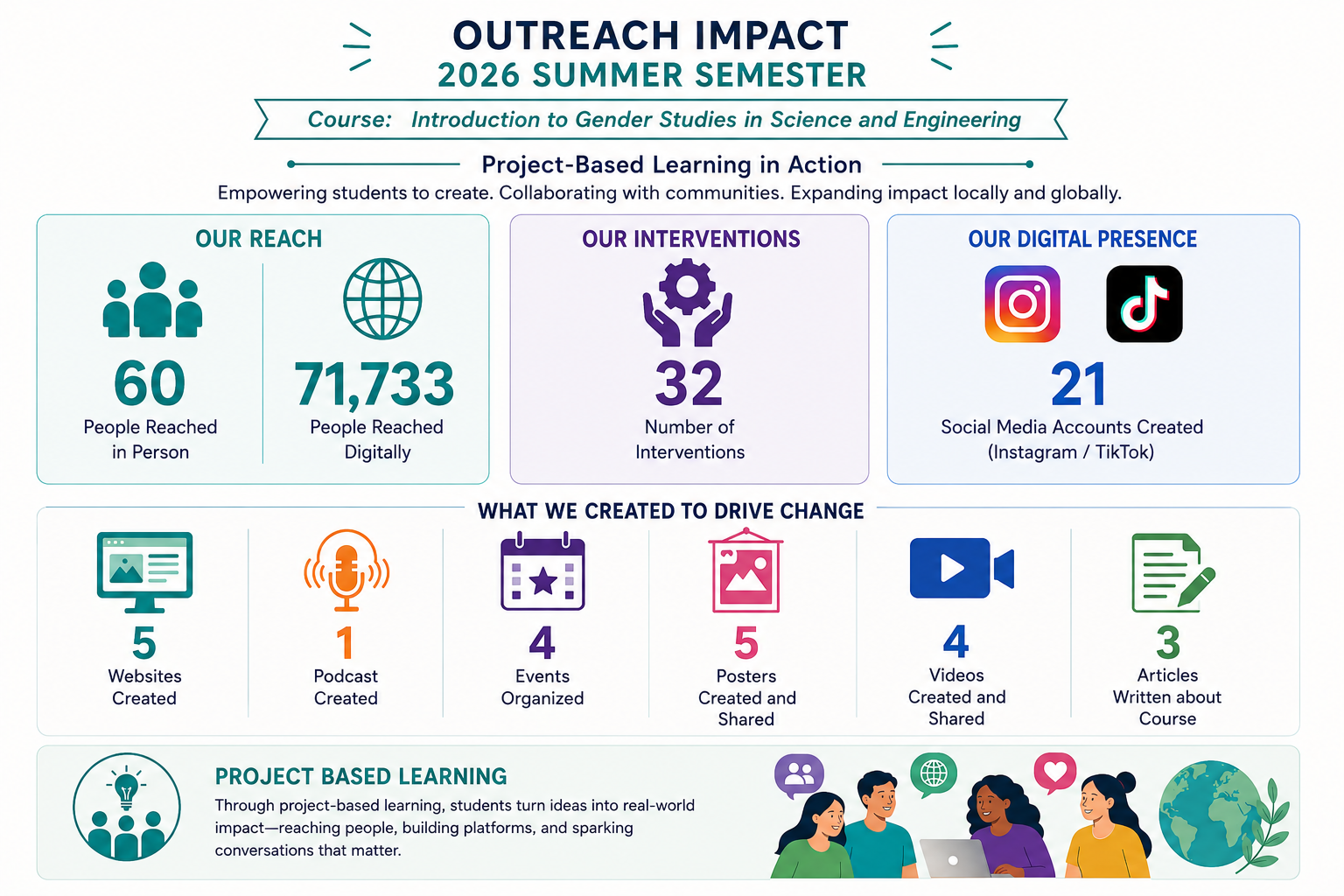
The course aims to introduce future scientists and engineers to sensitive issues in their fields in a tangible way, through project-based learning. We are exploring, for example: Why are there so few women in STEM? What impact does this have on the knowledge and technology being produced? And what can we ourselves do to make science more inclusive? The students, who come from a mix of fields—computer science, artificial intelligence, biological chemistry, and chemical technology—form teams and define, design, and carry out a project over the semester. Within the framework of the project, they map out a problem related to gender issues within their own field, and then propose a brief intervention project, that is, a practical attempt at a solution. Student intervention projects range from social media campaigns, websites, podcasts, poster campaigns, stickers and flyers, as well as treasure hunts, school visits, and public lecture events. The essence of course is to give students the experience of working in a diverse team setting, while connecting with an inclusivity issue in STEM in a creative way. Students become agents of change, as they bring science to people outside of the classroom walls, and the course a large intervention itself, with an outreach impact of 70K+ people every semester.

Student Testimonials
“This course was about understanding how gender shapes people’s experiences, opportunities, and treatment in society. It encouraged us to critically examine social norms, stereotypes, and structural inequalities, while exploring how these issues affect different areas such as education, work, healthcare, and everyday life. The course also emphasized reflecting on our own assumptions and considering ways to contribute to a more inclusive and equitable society.”
“This course is very useful as a means of getting people to delve deeper into issues they already know about on a surface level. Knowing that gender bias and other stereotypes negatively affect people in STEM careers in one thing, but actively studying and talking about these issues helps to understand their impact better.”
“Very fun and hands on project based course. I had a lot of fun experiences working with my group. It was great to learn about intersectionality and grey areas when it comes to gender biases in STEM.”
In the Media
April 23, 2026
Making Students Be the Change in STEAM
In this article, published in the resource center of the European project STREAM IT, the course is featured as an example of best practices that brings together science and art to make a positive impact on STEM.
March 08, 2026
The Celebration of Women’s Achievements (in Hungarian)
In this article, on the John von Neumann Computer Society’s website, we reflect on International Women’s Day and how such interventions can make a lasting change for women.
February 11, 2026
Girls and Women in Science: Student Projects for Equality (in Hungarian)
In this article, on the John von Neumann Computer Society’s website, we address the most urgent issues that arise in connection with the International Day of Women and Girls in Science, reflecting on the power of students’ creativity to impact change in STEM.
Learn about Past courses
Dr. Szlavi taught this course in the summer school of Eotvos Lorand University Budapest, with the aim of offering insights, best practices, and case studies into gender equality and DEI considerations in User Experience and Software Design. The students came from different backgrounds and nationalities, all with an interest to better understand their digital environments.
This course, created by Dr. Szlavi while working at Milestone Institute Budapest, applied project-based learning (PBL) principles, while guiding students through a journey of discovery into the complex and fascinating systems of languages. Students explore rules of syntax, morphology, and semantics of existing languages, then became code breakers and deciphered linguistic puzzled. Their project, throughout the course, was to build their own code of a “language” for their peers to break and make sense of.
With a long tradition at the Norwegian University of Science and Technology, this course is based on project-based team work, in which student teams work on real-world problems, collaborating with local tech companies and aided by so-called supervisors. Dr. Szlavi was a member of the teaching team, supporting a team of students working on an AI and sustainability challenge at a Norwegian tech firm.